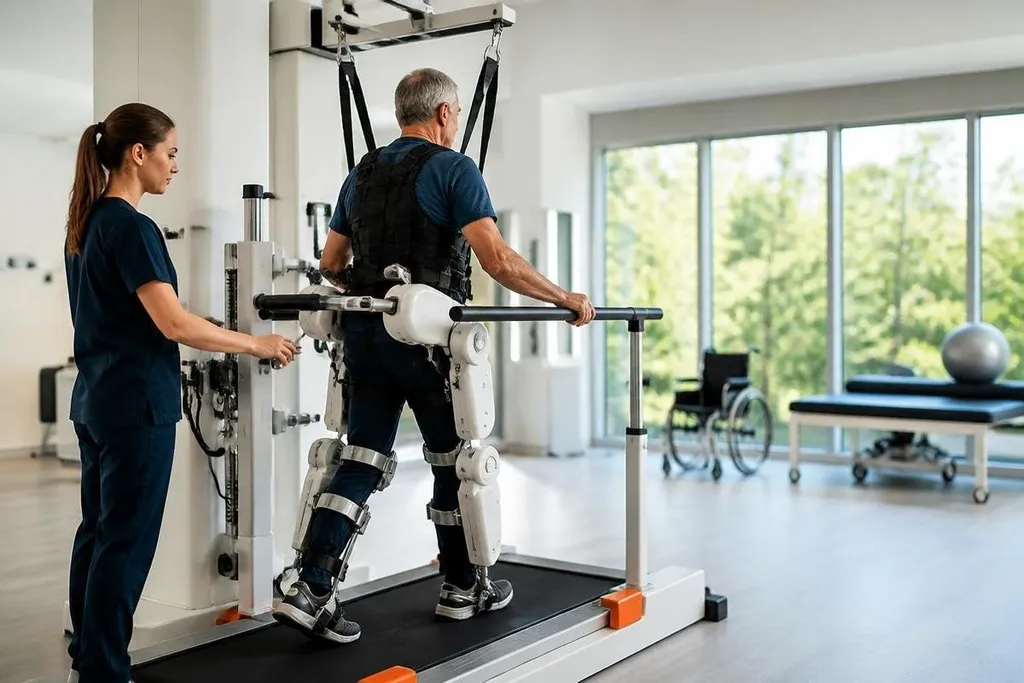
Rehabilitation robots are moving from fixed movement patterns toward systems that adjust help during a session. The change matters when a patient’s strength, balance, or walking pattern shifts from one attempt to the next.
- Adaptive support: the robot can change the force or speed during a task.
- Motion data: sensors record how a patient moves, not only whether they finish.
- Clinical control: therapists still set the task, limits, and safety rules.
Where AI fits in the robot
A rehabilitation robot combines motors with sensors that measure position, force, speed, and contact. AI software reads those signals and estimates how much help the patient needs at that moment.
That estimate can drive an assist-as-needed mode. The robot gives more support when a leg buckles or an arm slows, then reduces help when the patient takes more of the load. The goal is to keep the person doing the task rather than moving them through it.
This process is different from a fixed program. A fixed program may repeat the same path at the same speed. An AI system can compare the current motion with earlier attempts and change the next movement within limits set by the therapist.
The software still needs a clear job. A model might spot a change in step timing, joint angle, or force. It should then connect that change to a safe response, such as lowering speed or stopping the motor.
What changes for patients and therapists
For a patient, the main change is the level of help. A robot can make a task harder after stable attempts, or add support when fatigue affects control. That can let a session stay close to the patient’s current ability instead of following one setting from start to finish.
For a therapist, the value sits in the record around each movement. Session data can show how much force the robot supplied, how often the patient needed help, and where control weakened. Those details can guide the next session, provided the data is clear enough to check.
AI can also help sort movement data into patterns. A therapist may see that a patient reaches a target but shifts weight poorly, or walks at the right speed with uneven steps. A task score alone would miss that difference.
A robot’s score still needs clinical context. A higher repetition count does not prove better recovery if the patient used too much support or moved with poor form.
Safety and the limits of adaptation
Adaptive control adds a safety problem because the robot is changing its behavior while a person is attached to it. The system needs hard limits for force, speed, joint range, and emergency stops. Those limits should remain active even when the AI model makes a poor estimate.
Training data creates another limit. A model built from one group of patients may read a different body shape, movement pattern, or assistive device poorly. A therapist needs a way to see when the software is unsure and take control.
The largest gap sits between a clean robot task and daily life. A patient may improve on a supported treadmill or arm exercise without showing the same change while walking across a room or reaching for a cup.
AI can measure the training task closely; it cannot by itself prove that the skill transfers outside the clinic.
A rehab robot’s AI claim needs the task, patient group, model, and test result beside it. A report on Robot24.com can give you those details before you compare the robot’s price, setup time, and limits.
What to check before buying
A clinic comparing systems should ask:
- Control limits: Can staff set force, speed, joint range, and stop rules by task?
- Data access: Can the team export session data in a usable format?
- Model checks: Does the system show uncertainty or flag unusual movement?
- Patient fit: Has the maker stated which conditions, body sizes, and assistive devices it supports?
- Human control: Can a therapist change or stop the robot without waiting for the software?
- Proof of transfer: Has the maker measured changes outside the robot task?
These questions separate an adaptive feature from a useful clinical tool. They also show what remains unproven: whether the model works across patients, settings, and stages of recovery.
I’d judge a rehabilitation robot by how well it keeps the patient active while giving the therapist control, not by the presence of AI in its brochure.
The next useful evidence will be patient results tied to clear control settings, session records, and movement outside the robot. Until those links are shown, AI is a way to adjust rehabilitation support, not proof that recovery will improve.